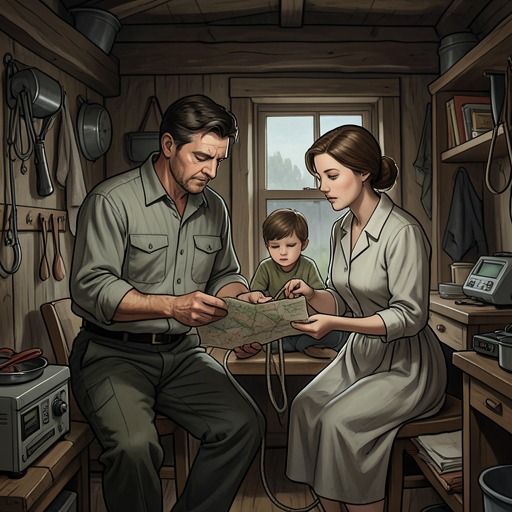
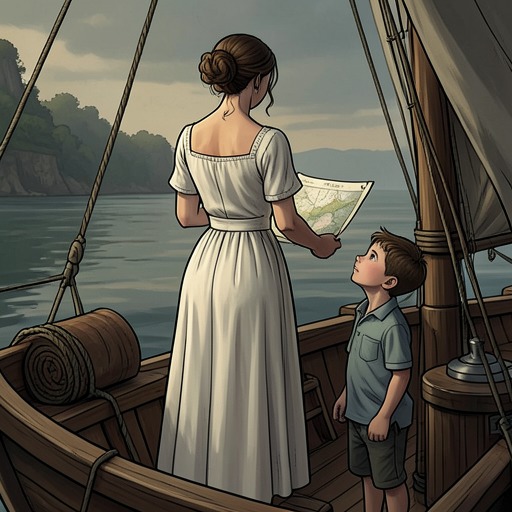
Michael and his mother
Kensuke's KingdomMichael and his mother share a relationship formed in the ordinary pleasures of family life and remade by a voyage that takes them far from home. She is at once the family’s sailing skipper, a determined parent whose illness threatens the voyage, and the person who refuses to accept that Michael has been lost for good. Their separation makes that conviction more than a private feeling: it becomes the force that keeps the search going until the family is reunited.
Family Life and the Decision to Sail
Before the voyage, sailing belongs to the family’s Sundays. Michael remembers his mother at the tiller in her blue cap, able to find and catch a breeze; she relishes the open air and calls the experience wonderful. When the reservoir is rough, the family skims over the waves, and when there is no wind, they fish instead. These memories establish her as an assured sailor and place shared time on the water at the center of the family’s life.
That life is unsettled when the brickworks employing both parents closes. Michael’s father sells the car and proposes moving south, but his mother resists leaving their house, Grandma, and school. The later sailing plan gives their family a new direction: his father describes a carefully prepared round-the-world voyage, and Michael’s mother asks whether she will be skipper. His mock salute confirms her command. The voyage is not simply his father’s project; the plan gives her a defined role and makes her sailing ability central to the family’s shared undertaking.
A Skipper and a Close Companion at Sea
The family sets out aboard the Peggy Sue on September 10, 1987, with Michael’s mother as skipper. During training, she masters the books and charts through sustained study. Michael is impressed by the contrast between her earlier competence on the reservoir and the work she puts into preparing for a much larger voyage. At sea, she does not show fear during the family’s worst moments, even when high waves leave Michael and his father silently frightened. Her composure and command help the family gain confidence in both her and the boat.
The relationship is also close in the practical, confined life aboard ship. Michael’s father becomes his friend and shipmate; his mother is the skipper whose authority the others trust. Though she can be strict about keeping the boat shipshape, Michael recalls that he and his father were proud of her and confident she could take them around the world and back. Their family life is reorganized around watches, charts, and sailing work, so that care and authority become part of the same daily partnership.
The voyage offers moments when that partnership feels triumphant. On October 11, Michael sees Africa in the distance, and his mother identifies it and shows him the route on the chart: down the west coast, then across the Atlantic toward South America. Off Perth the following April, the family celebrates reaching Australia, halfway around the world from England. They hug and jump together at the sight of land. Michael’s mother’s role as navigator and skipper is woven into these shared achievements, not separate from them.
Illness, Separation, and the Search
The same journey also exposes a danger the family cannot solve through seamanship. Michael’s mother has recurring stomach cramps; when the family reaches Australia, she promises to see a doctor. After they leave Sydney, however, the storms across the Coral Sea become severe, and her illness worsens. She cannot eat and has only sugared water. For three days she cannot consult the charts, while the rudder cable is damaged and the self-steering has failed. Michael’s father wants to send a Mayday call, but she refuses, treating it as surrender. Michael and his father take on navigation together, unsure of their position, while Michael keeps Eddie’s soccer ball near him and hopes his mother will recover.
On the dark night before Michael’s twelfth birthday, she and his father are asleep below while he keeps watch. Soon afterward, Michael falls overboard from the Peggy Sue and is left in the ocean as the boat’s lights disappear. The account makes the separation from his mother part of a wider rupture: he believes no one can hear him and fears he will not survive. On the island, he later describes himself as feeling like an orphan, abandoned and alone. That description conveys the emotional consequence of losing contact with his family, even though he does not know what his parents believe or what they are doing.
His mother’s response to the disappearance is disclosed only when the Peggy Sue reaches the island. She has searched with Michael’s father for almost a year, sailing from island to island despite other people’s disbelief that Michael could still be alive. His father eventually admits that he had given Michael up for dead; his mother never did. Her certainty that he was alive is presented not as proof or a miracle, but as faith that sustains action: she keeps searching until she finds him.
Reunion and the Meaning of Their Bond
At the reunion, Stella Artois runs out to the arriving Peggy Sue, while Michael waits in the trees before coming onto the sand to meet his parents. His mother cries and hugs him, repeating that she had said they would find him. The embrace answers the long separation with immediate physical closeness; her repeated words also confirm that hope had endured through the search rather than being created only by the reunion.
Michael’s mother and father return to him, but the encounter is shaped by the life and bond he has formed on the island with Kensuke. Before the ship arrives, Kensuke asks Michael to promise that he will think of him when he is home in England, looking up at the full moon. The promise makes clear that returning to his family does not erase his other attachment. For Michael and his mother, reunion restores their family relationship; in the wider story, it also marks his return to a home that now has to include the memory of the person he leaves behind.
The relationship’s arc runs from shared Sundays on a reservoir, through an ocean voyage in which mother and son depend on one another, to an involuntary separation and a year-long search. His mother’s role changes from confident skipper beside him to the absent parent whose faith brings him back within reach of home. The story gives her persistence a concrete outcome: she and Michael’s father find him, and she holds him again.